Before a new collection is created, the company and designer needs to understand how people react to fashion trends and what some historical fashion trends are. The article argues that fashion trends are shaped by consumer's income, historical trends and attempts to self-brand. Jr. Thorpe talked about her interpretation of fashion trend in the article Where do fashion trends start? Why do people care about what’s in style, and what it really represents? published on website Bustle, which is an online community providing information of objects women are obsessed with.
Jr. Thorpe states that the first appearance of fashion trend was caused by disposable money, leisure time, and the wanting to keep up with the society. It’s true that the first condition for pursuing fashion trends is to have spare money so that people won’t have no roof over head in order to purchase new stylish clothing. She also says that “One is a social status one: as fashion trends trickle down from the high echelons of society (fashion houses and celebrities), across (from other countries) or up (from urban fashion, "street style," or punks), they allow us to demonstrate our wealth and hipness through emulation.” People in different classes who follow the trends usually have the emulation, the desire to compare with others externally. She mentions that having a current fashion trend is a way for companies to produce profits because it encourages people to buy clothes for different seasons for matching the fashion trend, and the rapid cycle of fashion maximizes the profit due to “the onset of trends keeps us buying for fear of wearing "last year's stuff" — so more money goes to the fashion industry.”
I think her article is very realistic even though it shows slight prejudice that pursuing fashion trends makes people only pay attention to appearance. Jr. Thorpe used to work in fashion field, so her words are relatively credible. And I view fashion trend as designers’ perspective of the world for a period of time. Designers express their feelings of the world, whether is the real world or their imaginative world, and that’s why and how a fashion trend start.
Another author Carey Dunne helped list the past fashion trends exhibited in Trend-ology, a new exhibition held at Fashion Institute of Technology Museum. Her article How Do Fashion Trends Start is on the business design website called Codesign and it talks about several fad fashion trends showed in the museum.
 |
| source: https://www.fastcodesign.com |
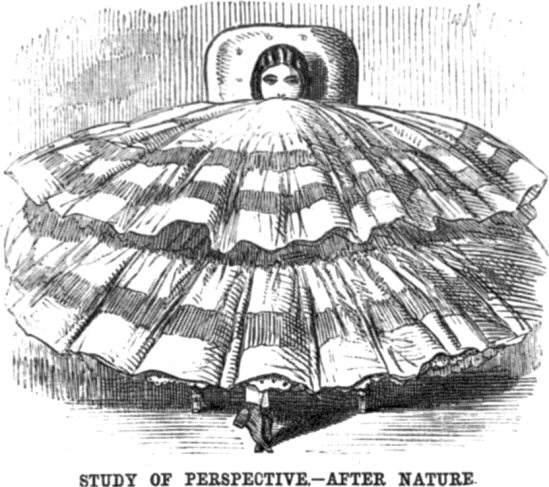
Dunne first mentions the trend of bustle, a device the women in 1800s used to hold their dresses standing and it created a perfect shape of a woman’s body. The article says that, “These devices cartoonishly exaggerated the idealized hourglass female shape while still concealing the body. As the 1854 poem "The Angel in the House" famously described, the ideal Victorian woman was demure and passive—and corsets and bustles helped keep them that way.” Corsets were hard to wear, and it actually hurt women’s body because wearing this tight device for years can force the ribs to move. But bustles and corsets were still the necessities of women in the past. And it was very inconvenient for daily life. The Punch Magazine said that “Sitting down in a crinoline could prove problematic if a woman didn't spread her skirts properly, causing the crinoline's hoop to fly up in her face—a phenomenon endlessly parodied by Punch magazine.”
 |
| source: https://fastcodesign.com |
 |
| source: https:// c.fastcompany.net |
 |
| source: https://www.fastcodesign.com |
At last, she states that the current situation is that trend’s changing faster and more global.
I think this article is pretty believable because it informs and reviews the historical fashion trends that used to be popular. And her statement is in agreement with Jr. Thorpe's, that fashion trend is changing way faster than decades ago and the influence is more global, and this situation helps companies to make larger profit from it because people are buying more "new trended" clothes.
My future blog posts will be introducing some designers who can start/change a fashion trend, how clothing companies hold fashion shows to present their new collections to the world, and how they use media to increase the population of the collections.

a. I really liked how you analyzed historical fashion and modern fashion with photos as well as quotes from reliable sources.
ReplyDeleteb. I think something that would be cool to do for future posts is looking at how consumers feel about the similarities. Do they like it or do they always want new looks and trends?